By Sheri Lambert
For the Fall 2025 semester, I decided to turn things up a bit in my undergraduate Marketing Strategy classroom.
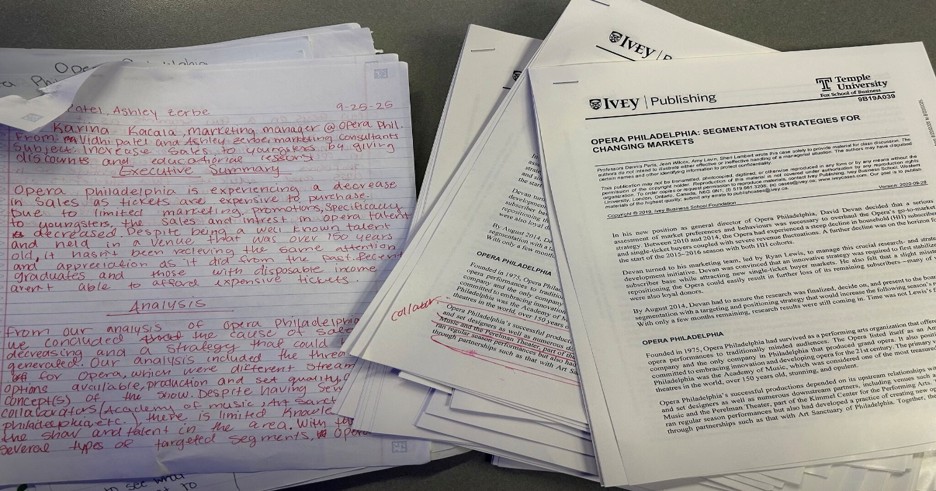
We kicked off MKTG 4501, the marketing capstone course at the Fox School of Business, with a case analysis of Opera Philadelphia: Segmentation Strategies for Changing Markets. But there was a twist: No cell phones. No tablets. No laptops. No internet. No Google. And, perhaps most importantly, no AI. Instead: a printed case, a pen, some paper, and a room full of students. In other words, we went old school.
I wasn’t trying to make a statement about technology or AI. Quite the opposite. I use AI in my teaching, and I believe students need to learn how to work with AI effectively, critically, and ethically. But as AI becomes increasingly embedded in our classrooms, I found myself wondering about something more fundamental: What happens to student learning when we take away the tools that can help students get to an answer quickly?
So, I decided to find out.
The Case for Slowing Down
The case method has always required students to wrestle with ambiguity. There isn’t necessarily one right answer. Critical thinking is required. Students have to identify the problem, determine what information matters, make assumptions, evaluate alternatives, and ultimately defend a recommendation. Those are difficult cognitive tasks. And they are precisely the kinds of tasks that generative AI can make easier.
Give an AI tool a case and a well-crafted prompt, and within seconds you can have a reasonably coherent analysis. Ask it to identify the central problem, generate alternatives, apply a framework, and recommend a strategy, and it will happily oblige. The result may even be good. But “good” isn’t necessarily the same thing as “learning.”
That distinction has been increasingly on my mind as I teach in the age of AI. If students can outsource portions of the analytical process, how do we make sure they are still developing the ability to think? How do we create classroom experiences where students aren’t simply evaluating an AI-generated answer, but are actually building the analytical muscles they will need when there is no prompt, no framework, and no chatbot waiting to help?
For this particular class, I decided that the answer was simple: Take the technology away.
A Different Kind of Classroom Energy
The students received the Opera Philadelphia case and a set of questions. Yes, I killed trees and printed out the 15-page case for the students to read in class. (Full disclosure: I asked the students to read the case prior to coming to class.) At the start of this particular class, when asked if they had read the case, the lion’s share of students confessed that they had not. As for the questions, I shared those on the board.
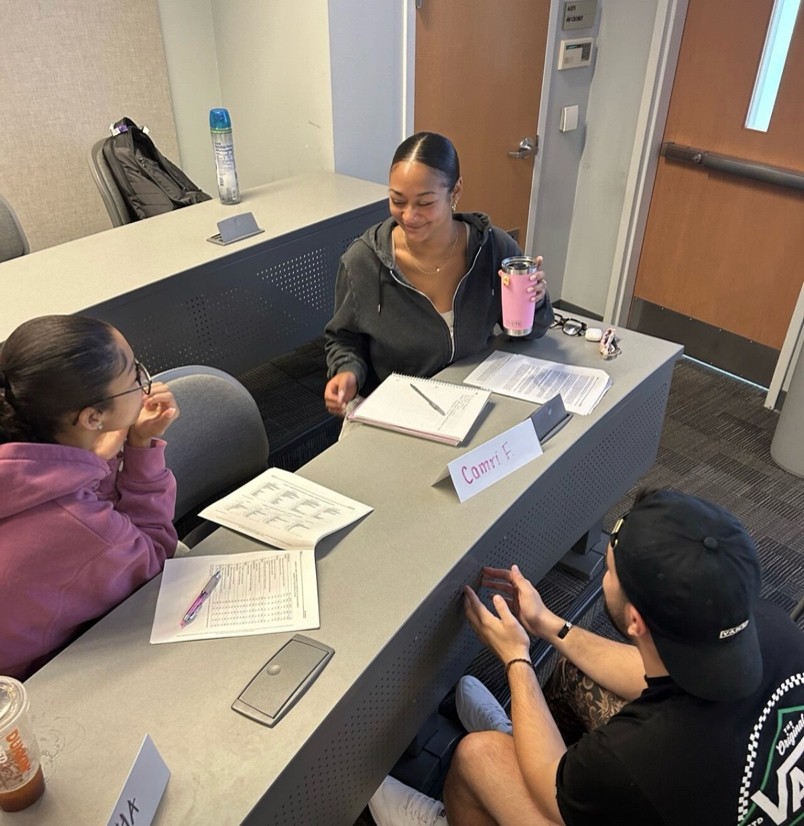
After the hard copies of the case were distributed to each student (a class of 48 undergraduate seniors), I proceeded to put them in groups of three or four and asked them to put their cell phones, tablets, and/or laptops in their backpacks. Gasp!
We read the case. Then we started talking. And we kept talking.
Students debated what they believed Opera Philadelphia’s real challenge was. They questioned each other’s assumptions. They pointed to details in the case. They changed their minds. They disagreed about which customers mattered most and what the organization should do next.
There were no screens glowing around the room. No one was quietly typing while someone else was talking. No one was Googling a competitor or looking up a statistic. And no one was asking ChatGPT to settle an argument. They were simply . . . there. Together.
It was one of those classroom moments that every instructor hopes for. The room felt focused, curious, and alive—and engaged in the moment!
I watched students lean forward when someone made a compelling point. I watched them flip back through the case to find evidence. I watched them challenge one another, not because I told them to, but because they genuinely wanted to resolve the disagreement. And perhaps most interestingly, they seemed to enjoy it. At least, they appeared to.
Of course, one energetic class doesn’t prove that banning technology produces better learning. Nor am I suggesting that we return permanently to a world without laptops or AI. But the experience did reinforce something I think we sometimes forget:
Learning can be uncomfortable. And that discomfort can be productive.
Productive Friction
One of the advantages of AI is that it reduces friction.
Need ideas? Ask AI.
Need an explanation? Ask AI.
Need five strategic alternatives? Ask AI.
Need help organizing your thoughts? Ask AI.
That convenience is extraordinary. It is also precisely why educators need to think carefully about when friction is actually part of the learning experience. Sometimes the struggle is the point.
There is value in sitting with a blank sheet of paper and not knowing the answer yet. There is value in reading a case twice because the first time you aren’t sure what matters. There is value in arguing with a classmate and discovering that your initial interpretation doesn’t hold up.
Those moments force students to make meaning rather than simply receive it. And that distinction matters. When students immediately turn to AI, they may get an answer before they have fully formed a question. They may see a polished recommendation before they have wrestled with the underlying problem. They may encounter a framework before they have determined whether the framework is actually useful. The technology isn’t necessarily doing something wrong. But it may be doing something for them that I want them to learn how to do themselves.
This Isn’t an Anti-AI Argument
I want to be clear: I am not advocating a return to an AI-free classroom. That would be unrealistic and, frankly, counterproductive. Our students are entering workplaces where AI will be part of how they research, analyze, communicate, create, and make decisions. They need experience using these tools. But they also need to know when not to use them. That is a different kind of AI literacy. Perhaps the question we should be asking isn’t “How do we stop students from using AI?” Instead, we might ask:
“What thinking do we want students to be able to do before they turn to AI?”
That question changes the instructional design challenge. It means we can create some assignments where AI is encouraged and explicitly integrated. We can ask students to critique AI-generated recommendations, compare their own analysis with an AI analysis, identify hallucinations or weak assumptions, and improve an AI-generated response. But we can also create moments where the technology disappears. Not because AI has no place in the classroom, but because thinking does.
The Analog Case
For me, the Opera Philadelphia exercise was a reminder that sometimes the best teaching innovation isn’t adding something new. Sometimes it’s taking something away.
The printed case became a shared physical object. Students could underline passages, circle numbers, write questions in the margins, and flip back and forth between pages. Their notes became visible evidence of their thinking. And the conversation became the technology. And the “written word” became the turned-in assignment.
That may sound nostalgic. Maybe it is. But there was something powerful about creating a temporary environment in which students had nowhere else to go for an answer. They had to rely on the case, their classmates, and themselves. And that forced a different kind of participation.
They couldn’t hide behind a screen. They couldn’t wait for an AI-generated response to give them something to say. They had to have an opinion (and then they had to defend it).
What I Learned
Bring notebooks or paper to the classroom. Bring pens or pencils. The students don’t have these items readily in their backpacks (or perhaps they don’t have them at all).
And another big learning: the assignment took a long time to grade. [smiles] Much longer than it would have taken if I were simply looking for polished, perfectly structured typed responses. There were misspellings. There were grammatical errors. Some sentences were awkward. And, honestly, I loved it—because the responses were uniquely theirs.
I could see their thinking on the page. I could see where they understood something, where they were struggling with an idea, where they made a connection I hadn’t anticipated, and where they were still working their way toward an answer. There was no sense that I was reading a collection of generic responses, or a polished version of something generated by AI or written by someone else.
It was their writing. It was their thoughts. Put down on real paper, with a pen or pencil. And that made the grading feel different. I wasn’t simply evaluating the quality of the final product. I was seeing evidence of the learning process itself.
But perhaps the best evidence of engagement came after the class was over.
I heard students talking about the exercise outside of the classroom, in the halls of Alter Hall at the Fox School of Business. They were still discussing what we had done. They were comparing what they had written, talking about their decisions, and revisiting the questions we had wrestled with in class. And surprisingly, they were not complaining (and while in the classroom, they definitely were NOT sleeping).
GASP! BAM! WOW!
That was the moment I knew something had happened. The conversation had left the classroom.
That experience reinforced something for me: engagement isn’t always about making learning easier, faster, or more convenient. Sometimes engagement comes from making students work a little harder. Sometimes it comes from giving them a problem they can’t immediately solve. And sometimes, in a classroom increasingly surrounded by technology, it comes from taking the technology away.
The irony isn’t lost on me: I’m writing an article about teaching in the age of AI after deliberately banning AI from my classroom.
But perhaps that’s the point.
As educators, our challenge isn’t to compete with AI. It is to design learning experiences in which students have opportunities to think, struggle, make connections, and develop their own ideas—and to use AI when it enhances that learning rather than replacing the intellectual work we want them to learn to do.
So yes, we went back to basics:
Pen.
Paper.
Conversation.
No screens.
No Google.
No AI.
Just students trying to figure something out together.
And honestly? It was pretty great!