By Geoffrey Friesen, Robert Mackalski, Seth Polsley, and Marc Ducusin
Image generated using ChatGPT
As a pedagogical method that places students in the shoes of decision-makers tackling real-world problems, case studies have been a staple in business education for over a century. This longevity can be attributed to the value that case-based learning delivers in the classroom. By challenging students to analyze, evaluate, and resolve applied issues, the case method cultivates deep, holistic, and nuanced understandings of course content, while providing context to theory and giving voice to those whose interests are often ignored.
In addition to reinforcing critical thinking skills essential to career success, the case method builds student confidence and facilitates collaborative learning, as students often work in teams to analyze and present cases, mirroring the teamwork required in the business world. However, while the case method remains vital to business education in the digital age, the availability of artificial intelligence (AI) tools threatens its value to higher education.
Previous advances in technology had a mixed impact on education. Access to the internet, for example, improved class discussions by facilitating information retrieval. Yet originality in student output suffered. In addition to contributing to a growing uniformity of ideas and patterns of writing, the digital age enabled students to cut and paste from online source material, which encouraged plagiarism and patchwriting, a term coined in 1993 by academic Rebecca Moore Howard to describe the practice of “copying from a source text and then deleting some words, altering grammatical structures, or plugging in one-for-one synonym substitutes.”
Academic dishonesty existed long before the internet became a household tool. As pointed out in “Cheating in Academic Institutions: A Decade of Research,” a 2001 paper published in Ethics & Behavior by Donald L. McCabe, Linda Klebe Trevino, and Kenneth D. Butterfield, the first large-scale study of cheating in institutions of higher learning dates back to 1964. After surveying more than 5,000 students across 99 colleges and universities in the United States, researcher William Bowers found that three-quarters of respondents admitted to at least one form of academic dishonesty and half admitted to two or more.
Since the Bowers study was conducted, relying on student surveys to assess the extent of cheating has been complicated by weaker student understanding of plagiarism. As McCabe, Trevino, and Butterfield noted in 2001, “selected behaviors that students may have classified as plagiarism in Bowers’s (1964) study do not appear to be considered plagiarism by many students today.” In particular, the authors identified a weaker understanding of “the need to cite the presentation of someone else’s ideas.”
Nevertheless, by late 1999, digital-age technology was being blamed for what U.S. News called “a new epidemic of fraud” sweeping through the educational system “from grade school to graduate school.” In an issue with a cover that read, “Cheating, Writing and Arithmetic,” a play on the traditional three Rs of education, the publication released the results of a poll that found that 84 per cent of college students believed they needed to cheat to get ahead.
By 2010, the internet’s impact on the digital generation was generating a debate over whether the concept of plagiarism had become obsolete. As The New York Times pointed out in an article entitled “Plagiarism Lines Blur for Students in Digital Age,” some argued that the concept of original authorship had no meaning for a generation that had come of age with music file-sharing and Wikipedia, while others insisted that “Generation Plagiarism” was just lazy.
However, blaming student plagiarism on laziness misses a major contributing factor. When explaining why students cheat in their 2001 paper, McCabe, Trevino, and Butterfield highlighted pressure to do well amid stiff competition for jobs. According to the researchers, after watching unethical peers get away with cheating, students who might otherwise complete their work honestly can be moved to break rules in order to “level the playing field.”
Simply put, pre-AI technology didn’t just make it easier for dishonest students to cheat; it pressured ethical students to follow suit. And while today’s AI applications obviously have a lot to offer, the threat to education from advances in technology has never been greater thanks to applications such as ChatGPT, which enables students to complete entire essays without any reading or analysis whatsoever while also increasing the pressure on ethical students to cheat in order to “level the playing field.”
This doesn’t just complicate the evaluation process for instructors. Early research suggests that dependence on AI technology can have a significant negative impact on educational outcomes. After examining AI usage in the educational context of essay writing, an ongoing academic project (see “Your Brain on ChatGPT”) found that students who relied on large language models (LLMs) to craft essays were less cognitively engaged with the subject matter and “fell behind in their ability to quote from the essays they wrote just minutes prior.”
As Bowers warned in 1964, the student who “passes through college with only a fragmentary and partial knowledge of the subject matter of his courses, is deprived of many of the fruits of the educational process.” Meanwhile, when good grades go to those who cheat, the “grading system loses its power to motivate students to take their studies seriously.”
With the future value of teaching business cases in question, this article examines several factors that must be weighed as educators attempt to successfully navigate the AI era. Instead of banning AI usage, we argue it should be demystified, normalized, and thoughtfully integrated using a new elevation matrix designed to eliminate concerns over student usage of AI tools in case-based learning.
Banning AI
Existing technologies can help enforce the prohibition of AI, but they have drawbacks. To discourage the use of ChatGPT and similar programs, some university instructors have turned to AI-detecting software such as GPTZero and Turnitin. However, anecdotal evidence suggests that they are prone to false positives, especially when evaluating work from technically proficient or experienced writers.
In one false-positive case that we consider particularly chilling, a journalism major and NCAA Division I collegiate swimmer found himself suspended from both his university program and athletic team after detection software incorrectly flagged an essay he had written as being AI-generated. Despite being a top student and highly capable writer, he was only reinstated after presenting timestamped Google Docs that demonstrated his iterative writing process and validated the authenticity of his work.
This false-positive case not only had a negative impact on the student accused of academic dishonesty but also left a deep impression on his sister. She became understandably fearful of using AI herself, not because she intended to cheat, but because she recognized how easily her own writing might be misclassified.
The broad takeaway in this case is that punitive approaches to AI, particularly those that rely on detection algorithms, can introduce problems. They may risk undermining trust and pedagogical integrity, as well as creating a culture of anxiety, avoidance, and secrecy. Indeed, rather than demystifying AI and normalizing its capabilities as something to be interrogated and surpassed, these approaches can cast AI usage as illicit or dangerous—akin to forbidden fruit.
Completely forbidding the use of AI may further constitute unsound pedagogical practice by effectively denying students the ability to hone skills that they will be expected to have in the professional world. By way of analogy, the wholesale rejection of AI by business schools would be comparable to engineering schools banning the use of computer-aided design (CAD) technology. Despite sparking controversy when first introduced, CAD has become the industry standard and a necessary professional skill.
Normalizing AI
In an era of ever-improving technology, banning AI from the classroom isn’t just futile—it is pedagogically regressive. That said, any attempt to normalize AI usage in education must confront the growing issue of homogenized student output. While assuming that most of today’s students use AI, Geoffrey Friesen, an associate professor of finance at the University of Nebraska–Lincoln (and primary author of this paper), set out to address this challenge by enabling students to use AI responsibly as a thinking aid, not a thinking substitute, in case-study assignments.
After developing a new standard of evaluation designed to resolve AI-related issues in case-based education, Friesen gathered observations over three semesters and six sections of Finance 475, a capstone course with 50 students per class. He then modeled the following five-step approach for implementation in the classroom:
STEP 1 – Case assignment: The class is assigned a case to read.
STEP 2 – In-class discussion: The students are split into work teams before a class-wide discussion of the case.
STEP 3 – Elevated case analysis: The instructor assigns a case-study write-up based on specific questions and a provided rubric. “If I were in your shoes,” the instructor tells the students, “I would get a premium membership for an AI platform, upload the case, upload the rubric, and upload the questions.” The students are then shown a hard copy of an AI-generated write-up and advised that it would receive a baseline passing grade, so their work must be superior. In the words of the assignment instructions, students must “elevate beyond ChatGPT-level answers by integrating original judgment, cross-disciplinary insights, and in-class discussions.” Sample prompts are provided.
STEP 4 – Elevation matrix: The students are provided with an elevation matrix demonstrating the different tiers and criteria according to which their work will be assessed. The matrix includes examples of Tier 1 reasoning and Tier 2 reasoning (see Figure 1).
STEP 5 – Showcase work and augmented discussion: Finally, the class discusses the use of AI and how to surpass the quality of AI-generated work. Important distinctions are made between what AI does best and what inimitable contributions are made by the human mind.
Figure 1: Elevation Matrix
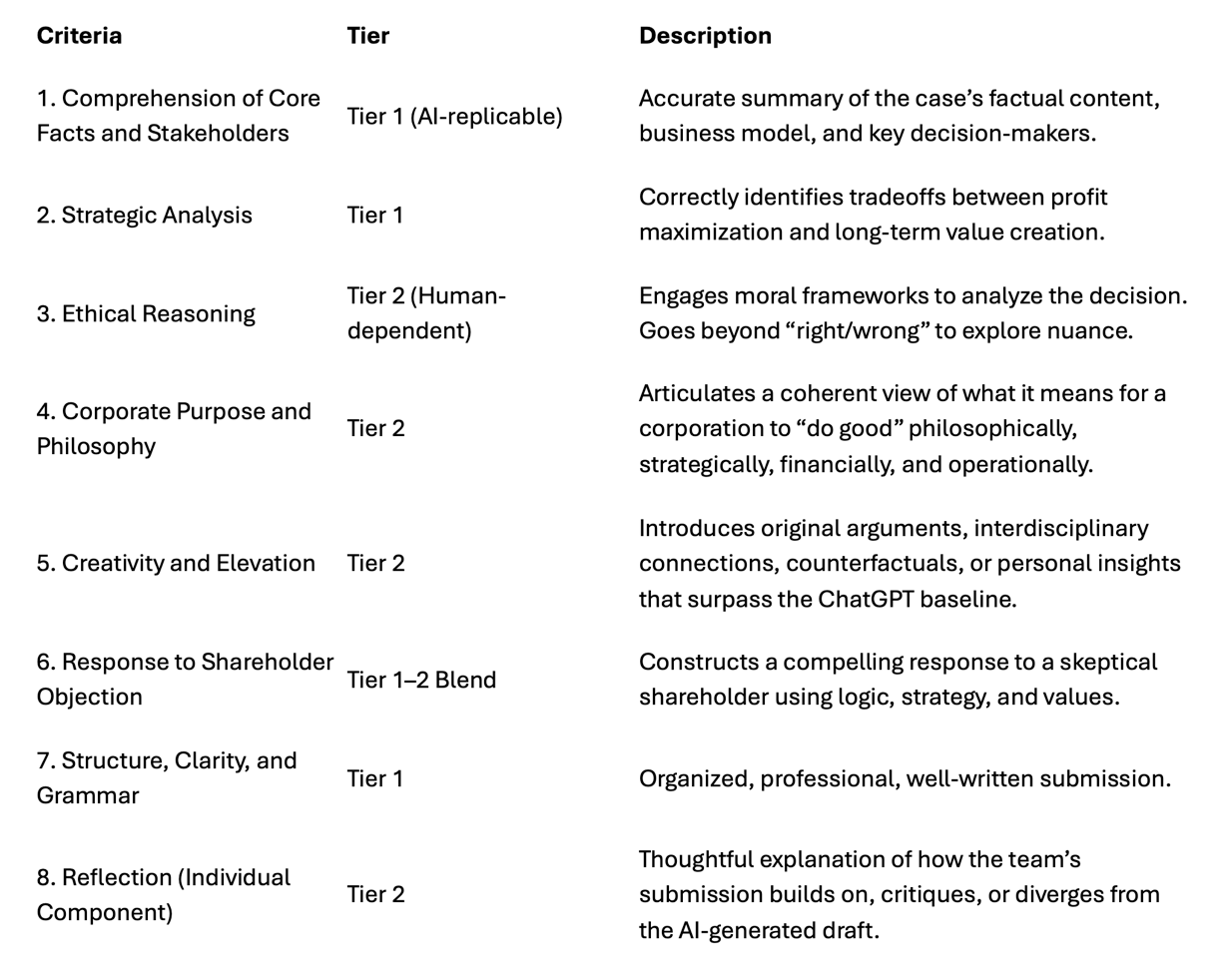
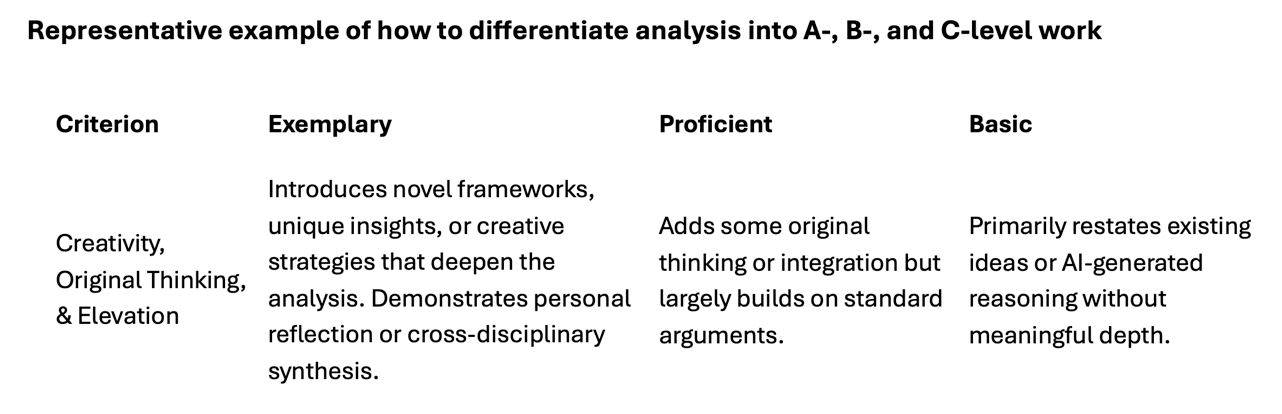
Like any technological tool, AI can have drastically different impacts depending on how it is used. The foremost takeaway of this article is that embracing AI in case-based education, rather than policing it, elevates student learning outcomes. As Friesen found, the five-step approach outlined above yields higher-quality papers and discussions because it targets the following four human capabilities that AI struggles to replicate:
- Judgment (e.g., “What tradeoffs really matter?)
- Moral reasoning (e.g., “What should a firm do?” rather than “What can it do?” or “What does it do?”)
- Synthesis, ownership, and voice (e.g., “What do I think?” or “Can I take a principled position and defend it?”)
- Contextual insight (e.g., “What did we learn in class that the large language model doesn’t know?”)
Simply put, the five-step approach proposed by this article harmonizes with the Massachusetts Institute of Technology’s “EPOCH” framework. The framework argues that education should pivot toward human capabilities not possessed by LLMs, such as empathy, creativity, moral agency, and judgment.
Student feedback in Friesen’s class clearly shows the value that can be gained by using AI to motivate creative thinking. On the Rate My Professors website, for example, one student called the case-study write-up the hardest assignment he had experienced to date, noting, “it gave me confidence to know I can create something better than AI, something I was scared of.”
Furthermore, just as the EPOCH framework emphasizes augmentation over substitution, the proposed approach encourages the potential of AI as a cross-trainer that builds mental fitness rather than as a crutch that allows the mind to atrophy.
Overall, AI doesn’t have to be banned from the classroom because it doesn’t have to be misused as a substitute for human thought. The normalization of AI demystifies its power while we redefine and elevate what constitutes “excellence” in the age of AI. As a result, contrary to fears that AI will jeopardize educational standards, the technology can actually help restore academic integrity through increased transparency.
AI, of course, also fosters new roles for instructors, who can adopt a proven procedure for training students in responsible AI use in the context of teaching case studies. By keeping up to date on the newest AI advancements, instructors can help equip their students with the latest knowledge about an increasingly prevalent tool in the professional world.
AI platforms can be intelligently harnessed as a powerful aid in the training of critical analysis and creative thinking. The restored emphasis on human ingenuity could not be more apt for the case-study method, which centralizes the unique, non-replicable perspective of a human protagonist at a crucial inflection point. The strategic use of cutting-edge AI technology and a time-honored case-study methodology thus points the way toward new pedagogical practices for the 21st century.
RESOURCES
- Bowers, William J. Student Dishonesty and Its Control in College. New York: Bureau of Applied Social Research, Columbia University, 1964.
- Colbert, Joel A., Peter Desberg, and Kimberly D. Trimble, eds. The Case for Education: Contemporary Approaches for Using Case Methods. Boston: Allyn & Bacon, 1996.
- Cote, Catherine. “5 Benefits of Learning Through the Case Study Method.” Harvard Business School Online, November 28, 2023. https://online.hbs.edu/blog/post/case-study-method.
- Howard, Rebecca Moore. “A Plagiarism Pentimento.” Journal of Teaching Writing 11, no. 2 (1993): 233–245.
- Howard, Rebecca Moore, Tricia Serviss, and Tanya K. Rodrigue. “Writing from Sources, Writing from Sentences.” Writing & Pedagogy 2, no. 2 (2010): 177–192.
- Ivey Business School. “Why Use Cases? Leading Case Practitioner Insights.” YouTube video, 8:18. September 5, 2017. https://www.youtube.com/watch?v=ITKP0onCyO0.
- Kosmyna, Nataliya, Eugene Hauptmann, Ye Tong Yuan, Jessica Situ, Xian-Hao Liao, Ashly Vivian Beresnitzky, Iris Braunstein, and Pattie Maes. “Your Brain on ChatGPT: Accumulation of Cognitive Debt When Using an AI Assistant for Essay Writing Task.” arXiv preprint, arXiv:2506.08872 (2025).
- Loaiza, Isabella, and Roberto Rigobon. “The EPOCH of AI: Human-Machine Complementarities at Work.” MIT Sloan Research Paper No. 7236-24, November 21, 2024. https://doi.org/10.2139/ssrn.5028371.
- McCabe, Donald L., Linda Klebe Trevino, and Kenneth D. Butterfield. “Cheating in Academic Institutions: A Decade of Research.” Ethics & Behavior 11, no. 3 (2001): 219–232.
- Nohria, Nitin. “What the Case Study Method Really Teaches: 7 Meta-Skills That Stick Even If the Cases Fade from Memory.” Harvard Business Publishing Education, December 21, 2021. https://hbsp.harvard.edu/inspiring-minds/what-the-case-study-method-really-teaches.
- Saunders, Mark N. K., and Bill Lee. Conducting Case Study Research for Business and Management Students. London: SAGE Publications, 2017.
This article was originally published in the Ivey Business Journal on May 14, 2026.