By Julian Birkinshaw
Learning anything new takes time—and it rarely happens without a struggle. Whether it’s speaking a second language, playing the piano, building an Excel spreadsheet, or understanding macroeconomic theory, learning happens through trial and error, practice and repetition, and expert coaching. There is typically doubt, frustration, and confusion along the way, but paradoxically, the more challenging the learning process is, the better it sticks in the end. Or to say it the other way round, if learning happens seamlessly and quickly, the knowledge gained may also be superficial and easily forgotten.
I use the term “productive friction” to capture this struggle that all learners experience. Productive friction has two parts to it. There is the “resistance” put in place by the learning designer, for example, problem sets, exercises, or mandated group work, and there is the effortful engagement of the learner, i.e., their active participation in the activity in question. Both are necessary for high-quality learning to occur.
Case teaching is a good example of productive friction in action. Typically, students are asked to read the case in advance; they then spend 80 minutes with an instructor discussing it. The discussion isn’t always that exciting, and many times it seems to go round in circles. At the end of the class, most instructors will summarize the key learnings in just a handful of bullet points, and the skeptical observer might ask: Did we really need an 80-minute discussion to reach these conclusions? For me the answer is yes—if the student was engaged for that whole time, contributing comments and listening intently to others, the learning points will be much more deeply understood than if the student tuned in for only the last five minutes of summary. This type of learning may seem to lack efficiency in the moment, but in the long term it is more effective.
Here is a graphical way of making the same point. When productive friction is low (for example, you are taking an online course, you watch the videos at double speed, and you skip the exercises), actual learning is likely to be very superficial. As the productive friction increases (for example, you might be required to have weekly tutorial meetings while doing the online course), learning increases proportionately as you put more effort in. However, if the productive friction is too high (for example, the online course might require you to do a written exercise after each video before the next is released), your motivation drops, you stop engaging, or you use generative AI (gen AI) to do the exercises for you; and the result is a weaker learning outcome.
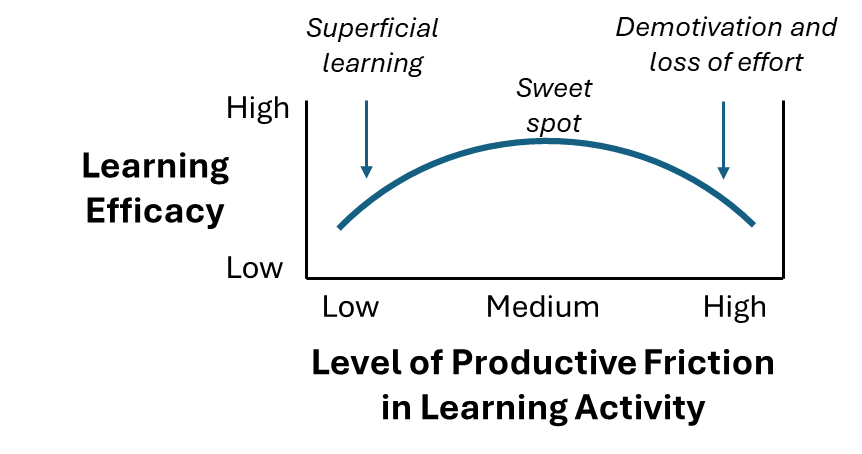
This concept of productive friction in learning has been around for many decades, with its roots in the work of educational pioneers like John Dewey and Jean Piaget. But it has never been more important than it is now because gen AI has suddenly transformed the possibilities facing students when tackling learning challenges. Simply put, gen AI enables the learner to reduce productive friction in whatever activity they engage in. Returning to the case method example earlier, many (perhaps most) students are using gen AI to summarize the case for them and provide them with speaking points to address the assignment questions. Some are typing the live conversation into gen AI during class to get real-time suggestions for how to contribute. Gen AI is also used by students to give them summary points and help them with preclass or post-class hand-ins. These tactics all help students to streamline their learning experience, but at the expense of actually gaining new knowledge.
Gen AI is equally effective at reducing productive friction in other aspects of learning. For example, it can do homework assignments for you, it can prepare texts and PowerPoint presentations, it can build spreadsheets, and so on. In terms of the graphic above, it has the potential to make every learning activity superficial. Needless to say, this is a huge problem for educators and students alike.
Solutions
So what should business school instructors do to counter the threat of gen AI? How can we reinforce the productive friction that enables high-quality learning? There are many tactics available. I will discuss them in the context of case method teaching, but the points are relevant to most other learning activities as well.
Keep the case method alive. Despite all the ways students are shortcutting case learning, it is still the most effective way of engaging a class around real-world business problems that we know of. So let’s not throw the baby out with the bathwater—let’s keep on investing in and evolving the case method so that it remains fit for purpose. In this gen AI world, we need the case method of learning more than ever.
Teach the case in a more action-oriented way. Gen AI does a good job of summarizing case materials for students, but it generally does a poor job of decision-making. It tends to summarize the pros and cons of a decision but without ever taking a definitive position. This suggests a rethinking is needed on how much time to spend on different parts of the case. Reiterating case facts might be dispensed with fairly quickly; decision-making and implementation might be given more time.
Push the students harder. One good way of exposing the student who used gen AI to summarize the case is to ask: “What are the facts or assumptions you are basing this point on? Please explain your underlying logic.” This is a good question to ask anyway, as it helps the student develop skills they will need in the workplace. But it also shows up the students who studied the case superficially—and hopefully gets them to do a more in-depth read the next time.
Rethink grading of contribution. In my experience it is necessary to have some portion of the grade linked to classroom contribution if you want a vibrant discussion. But with gen AI giving all students a leg-up in terms of answering the assignment questions in class, the grading of contribution needs to be more discerning, with a premium given to those students who are able to take the class in new directions, or to take an intentionally contrarian position.
Kill the devices. Some faculty I work with have banned devices from their case classes—smartphones are checked at the door, laptops are down, and everyone has a printed version of the case. This approach—essentially returning to an early 1990s classroom—has huge merits in terms of maintaining the productive friction of the case method. But it may be a bridge too far for some faculty. A halfway house solution I have seen used is for faculty to ask for laptops to be put down for 30–40 minutes during class, for example, to discuss the application of the case to their own experiences.
Don’t be afraid to use AI during the session. One of the risks of gen AI–enabled case learning is that the students all gravitate to the same analysis and the same answer. In this situation, as an instructor, you want to open up other possible ways forward. Of course you can do this yourself, by arguing a different course of action, but another option I have seen faculty use is to have their gen AI chatbot sitting in the class and asking it to generate a contrarian way forward. This helps to enliven the discussion significantly.
The guiding principle, across all these tactics, is we are trying to maintain productive friction in the learning experience in the face of gen AI technologies that remove friction. Sometimes this means using AI in creative ways; sometimes it means banning AI altogether from specific activities. Hopefully this short article has provided you with some useful tips and tactics to help you get the level of productive friction right.